



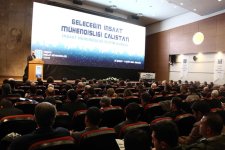
The Civil Engineering Workshop of the Future, organized by the Civil Engineering Education Board on behalf of TMMOB Chamber of Civil Engineers, was held on 28 February - 1 March 2025 at IMO KKM Teoman Öztürk Hall.
At the opening of the Workshop, which started with a video screening specially prepared for the 70th anniversary of our Chamber, the Chairman of the Organizing Board, Prof. Dr. Sinan ALTIN, IMO Chairman of the Board of Directors Nusret SUNA and IMO Ankara Branch Chairman of the Board of Directors Ahmet Onur ÖZGERGENE made a speech.
After the opening speeches, invited speaker Emin ÇAPA made his presentation titled Understanding and Being Ready for the New World, and Selçuk PEHLİVANOĞLU made his presentation titled Dynamics Building the Future: Education, Technology and Human Capital.
In the session titled Sociological and Demographic Changes in the World and in Turkey and Their Possible Effects on the Field of Civil Engineering, moderated by Selim TULUMTAŞ, Prof. Dr. Serdal BAHÇE Qualified Reserve Labor Force and Engineer, Prof. Dr. Gamze YÜCESAN ÖZDEMİR made their presentations on Civil Engineering in the Age of Crises and Searches.
Moderated by Prof. Dr. In the session titled Vision Changes in University Education in the World and in Turkey and Their Possible Effects on Civil Engineering Education, held by Metin HÜSEM, Prof. Dr. Tuğrul TANKUT Technology and Human, Prof. Dr. Metin GER Science-Technology-Production Spiral and Its Effect on Civil Engineering, Prof. Dr.They presented: Beno KURYEL, Analysis of Engineering Teaching in the Context of Instrumental Paradigm, Özer AKKUŞ, Development and Current Situation of Civil Engineering in Our Country.
Moderated by Prof. Dr. In the 2nd part of the session of Erdem CANBAY, Vision Changes in University Education in the World and in Turkey and Their Possible Effects on Civil Engineering Education, Prof. Dr. Mustafa TOKYAY, Vision Changes in University Education and Their Effects on Civil Engineering Education, Mustafa ÇOBANOĞLU, Changes in the Basic Philosophy of Engineering Education in the World - Adaptation Problems in Our Country, Zafer KIZILKAYA, made presentations on Ecosystem-Based Approach and Sustainable Conservation of Resources.
On the second day of the workshop, the moderator was Dr. In the session of Eren VURAN, Developments in the Field of Informatics and Their Possible Effects on the Field of Civil Engineering, Prof. Dr. Ahmet Hasan KOLTUKSUZ A Future Perspective Examining the Possible Effects of Developments in Computing Science and Technologies on Civil Engineering, Assoc. Dr. Onur Behzat TOKDEMİR New Generation Civil Engineering Supported by Artificial Intelligence: Digitalization, Automation and Digital Twins, Dr. Cemal YILMAZ Civil Engineering and Robotic Applications in the World of the Future, Dr. Onur BEKTAŞ made their presentation: An Evaluation on the Use of Geographic Information Systems in Infrastructure and Superstructure.
Moderated by Assoc. Prof. Dr.In the second part of the session on Developments in the Field of Informatics and Their Possible Effects on the Field of Civil Engineering, held by Sadık Can GİRGİN, Prof. Dr. Oğuz GÜNGÖR presented Spatial Data Collection and Processing Techniques in Civil Engineering, Utku HATİPOĞLU and Ramazan AYDINLI presented Artificial Intelligence and Civil Engineering of the Future.
The last session of the workshop, Changes in Civil Engineering Application Fields and Their Possible Effects on the Field of Civil Engineering, was discussed by Prof. Dr. It was moderated by Mustafa TOKYAY. In the session, Prof. Dr. Ilgın YAŞAR Smart Cities and Expectations, Prof. Dr. Lale BALAS and Assoc. Dr. Aslı NUMANOĞLU GENÇ Sustainable Management of Water Resources and Prevention of Pollution: Environmental Responsibility in Civil Engineering, Didem DAMYAN How Does the Transition to Clean Energy Change Civil Engineering Practices?, Assoc. Dr. Can Baran AKTAŞ Possible Effects of Environmental Impacts on the Field of Civil Engineering, Prof. Dr. Hakkı Oral ÖZHAN They presented: Evaluation of Wastes and Microplastics in the Field of Geotechnical Engineering, Contributions of Geotechnical Applications to the Prevention of Environmental Pollution.
To the symposium; IMO Chairman of the Board of Directors Nusret SUNA, 2nd.President Selçuk ULUATA, Secretary Member Bülent TATLI, Treasurer Member Özer AKKUŞ, Board Members Jale ALEL and Tansel ÖNAL, General Secretary Serap DEDEOĞLU, Deputy General Secretary Eylem GÜMÜZ YILMAZ, Board Members from IMO Branches and many colleagues attended.
Speech made by Nusret SUNA, Chairman of the Board of Directors of IMO, at the opening of the Workshop:
Dear Colleagues,
Dear members of the academy,
Dear Guests,
I welcome you to the "Civil Engineering Workshop of the Future" organized by TMMOB Chamber of Civil Engineers under the leadership of the Civil Engineering Education Board, and I greet you all with respect and friendship on behalf of the Board of Directors of the Chamber of Civil Engineers.
You will appreciate how much effort this workshop, organized on such a comprehensive and important topic, is. I would like to express my gratitude to our Civil Engineering Education Board, our Organizing Board, our colleagues, and the valuable speakers who contributed with their presentations, who played an important role in the realization of this workshop.
It is clear that the discussions to be held here today in line with the current developments in the field of civil engineering will contribute to both civil engineering education and the development of our profession.
Dear Colleagues,
Dear Guests,
Dazzling developments in the field of technology in the world naturally cause transformations in the construction industry. It is predicted that the spread of artificial intelligence and robotic technologies, the development of quantum computers and the expansion of the use of new software will lead to striking changes in the civil engineering profession. It is argued that traditional construction methods will be replaced by smart structures, digital workforces and data-based design processes.
These developments show that it will be insufficient to apply the knowledge learned at universities in the same way throughout professional life. For this reason, the need for qualified civil engineers who have developed intellectual power, have learned to learn, have adopted the understanding of lifelong learning, are investigative and solution-oriented, prone to interdisciplinary cooperation, and can quickly adapt to new technologies is increasing.
As the Chamber of Civil Engineers, we care about the development and future of our profession. We continue our work to increase the qualifications of our colleagues, to make vocational education compatible with scientific and technological developments, and to ensure safe and sustainable construction.Of course, at this point, it is a critical necessity to increase the quality of engineering education and ensure the competence of future civil engineers.
But it should also be stated that it is important to discuss all these without ignoring some of the realities of our country. Undoubtedly, a suitable academic environment is necessary for the production and development of scientific knowledge. The basis of providing this environment is free universities that raise individuals who can think freely, are away from dogmas, question, research, try and are eager to understand. Unfortunately, no university in Turkey has the conditions suitable to provide such an environment, and universities have become vocational training institutions rather than centers of science. In order for the university to be a true science center, it must first have a democratic functioning. The main duty of administrators appointed directly by political mechanisms has been to supervise these institutions on behalf of the political power, to prevent them when necessary, and to make them comply with the policies of the government.
A student who cannot think and question, who cannot research and criticize, who cannot express his views freely can only complete his undergraduate education by memorizing the information imposed on him.If we are talking about catching up with the developments in technology worldwide, we must first discuss the possibilities of training the manpower capable of doing this.
Our universities are far from providing this quality. Valuable academics from our well-established universities are being liquidated, their administrations are being made completely dependent on the political power, and students who show the slightest objection are being punished.
On the other hand, dreams are sold to young people with nameplate universities opened without any plan or program for the sake of political populism, and limited country resources are wasted. The qualifications of students graduating from these universities, who do not have the opportunity to meet even the most basic requirements such as classrooms, laboratories and libraries, are also a matter of debate.
In line with the profit-oriented structure of foundation universities, which see students as customers, resources allocated to research and development are reduced.
However, 100 years ago, Türkiye got rid of dogmas, understood the importance of scientific, secular and modern education, and with the steps it took in this direction, it carried out industrialization and production moves with a public understanding. As a country trying to catch up with its contemporaries in science and technology, it has made a leap forward compared to its time.
Despite the pessimistic picture we mentioned, we are aware that there are still many scientists today who have not lost their respect for their profession and science. With the strength we get from them, we insist on our professional and technical activities as we do here today. The existence of these scientists keeps our hope alive that universities will become true centers of science again.
Dear Colleagues,
Dear participants,
With valuable presentations throughout the workshop; The effects of sociological and demographic changes, vision changes in university education, developments in the field of informatics, and changes in civil engineering application areas on the profession will be discussed, and evaluations will be made together with experts, academicians and sector representatives.
However, as I said when expressing the situation of our universities, we cannot think independently of the reality of the country when evaluating the effects of these issues on our profession.
The budget allocated to science and technology development in Turkey is in a deplorable state in competition with the world. The ratio of R&D expenditure to GDP in Turkey is 1.42% as of 2023. This rate is 2.27 on average for EU countries. With these rates, Türkiye is at the bottom of the list of countries that allocate the most resources to R&D.Technology companies such as Google, Amazon and Meta alone allocate 3 to 4 times the resources of 16.1 billion dollars spent by Turkey for R&D studies.
This being the case, we cannot discuss the developments in technology and the effects of these developments on our profession from the subject position. We even argue that, let alone catching up with the latest developments in technology, our country cannot even provide engineering services that should be provided at a minimum level in the production of buildings. For example, we are still discussing the fact that, despite all our insistence, a civil engineer who has just graduated from university can assume the responsibility of being the site manager of 4 different jobs. We are discussing the fact that our colleague, who went to the inspection and tried to fulfill his duties completely, was attacked by the armed personnel of the contractors at the construction site.
Reviving certain interest groups through tenders received from the state, sacrificing urban areas for rent transfer, unnecessarily consuming the country's resources with PPP projects such as patient-guaranteed hospitals and passenger-guaranteed roads, although they have no public benefit, that is, while there are opportunities to earn very high profits in a short way - especially through the construction sector - R&D and production investments that will provide returns in the medium and long term do not seem attractive at all.
Dear colleagues,
Dear participants,
It is my belief that together we will build a future dominated by public policies that prioritize the development of our country in line with the perspective put forward by the founding values of the Republic. The purpose of these efforts is, in part, to achieve this goal.
We believe that our workshop will be an important step in presenting new ideas for the future, identifying problems and producing solutions. I would like to thank everyone who contributed once again and wish us a productive workshop.
Regards.